Showing posts with label article. Show all posts
on Wednesday, September 16, 2015
This "Notes on Morrowind" series of posts will be brief remarks on small topics related to The Elder Scrolls III: Morrowind Game of the Year Edition (dev. Bethesda Softworks, dirs. Todd Howard & Ken Rolston, 2003 [original game release 2002]) for PC rather than a holistic game analysis. All posts refer to the unmodded, version 1.6.1820 of the game played with maximum graphical and AI quality settings, a 1280x960 resolution, and all other settings at their defaults.

The Elder Scrolls series has prompted the creation of thousands of user-made game modifications ("mods"), and this community-driven development has become so prominent that it has become a major identifier for the franchise and selling point for the PC editions of the games. One of the more notable collections of mods are those by the TES Renewal Project (retrieved 2015-03-17). This team produces mods that recreate older Elder Scrolls games within the game engines of relatively newer Elder Scrolls games. For example, they host (although they didn't originally create) "Morroblivion," a mod that attempts to recreate Morrowind within the game engine of The Elder Scrolls IV: Oblivion. "Skywind," which is under active development, attempts to recreate Morrowind within the game engine of The Elder Scrolls V: Skyrim.

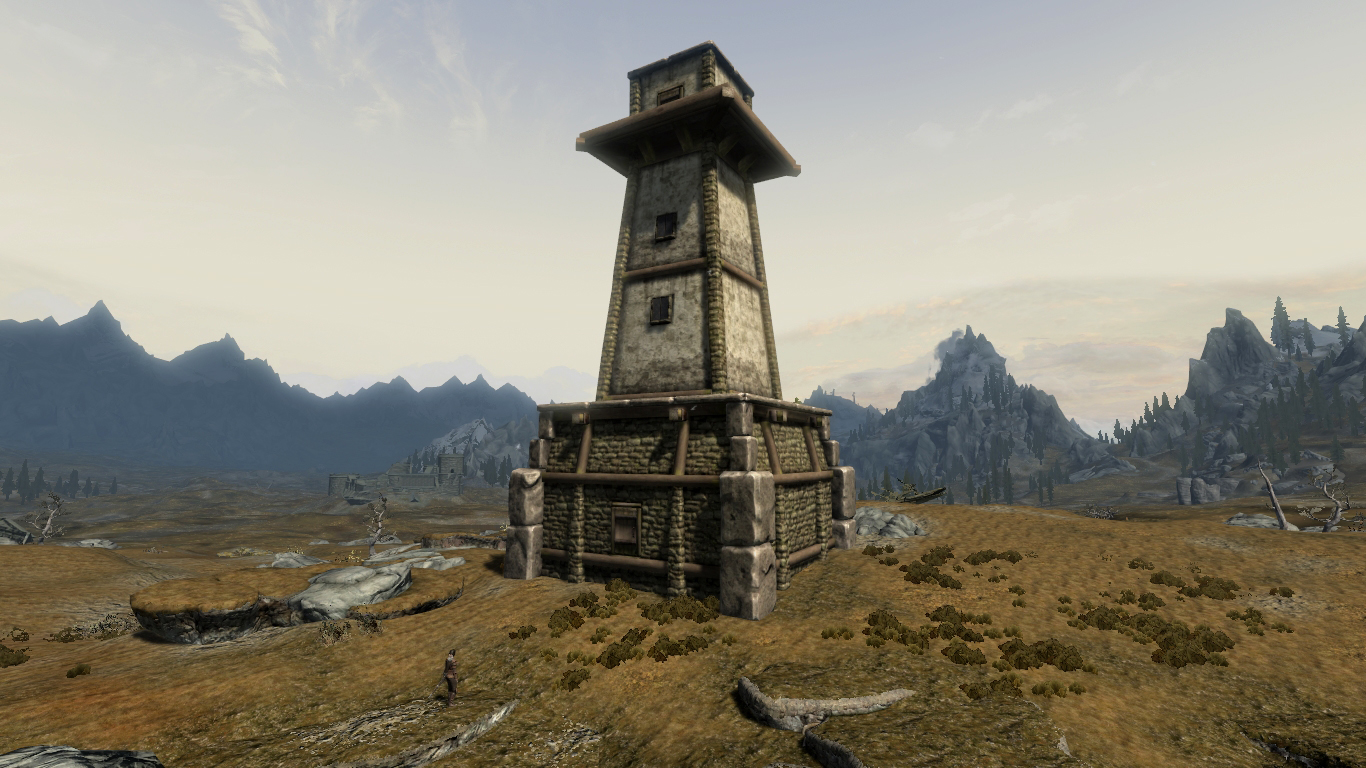
The off-kilter Seyda Need lighthouse.
As others have noted (retrieved 2015-03-17), such endeavors are less like recreations and more like complete reboots or reinterpretations, owing at least in part to the dramatic changes in game mechanics that they represent. As such, it should be obvious that they neither act to historically preserve of the games nor do they act as replacements for any purposes the original games serve. Nonetheless, as with similar projects for other games (e.g., Black Mesa, retrieved 2015-03-17), it is common to see online recommendations that players new to the Elder Scrolls series wait for "Skywind" to be released to "play" Morrowind, and perhaps even the developers of "Skywind" see the project as serving this purpose to a degree. Aside from the aforementioned problems with this line of thinking with respect to changed game mechanics, I want to highlight another type of problematic whitewashing of past game releases that occurs as a result of these sorts of projects and their desires to adjust the graphics of past games to present standards. To be very clear, when I call these issues "problems," I do not mean that it is a problem that projects like "Skywind" or Black Mesa exist in their present forms; I merely mean that these issues are problems for understanding the historical context of their source material when a large portion of player-base assumes a one-to-one mapping of the two texts. Really, I am just attempting to illustrate that these remakes are distinct texts by different authors that require new criticism relative to their source material. I'll illustrate this phenomenon by focusing on one small change to one particular building in "Skywind."

Interior bracing of lighthouse.
One of  the more memorable buildings in the game world of Morrowind is the Seyda Neen Lighthouse (retrieved 2015-03-17). Though not particularly notable from the perspective of the game's narrative, it is one of the first distinct buildings that the player is likely to encounter upon beginning the game because of its position in the starting town and its involvement in two minor quests. The lighthouse is peculiar for its architecture. It is built with simple, rough stone braced by interior wooden beams, and strangely, it is apparently off-balance and misaligned. The portion that houses the lighting element at the top is substantially off-center compared to the bulk of the structure, and the exterior stone staircase adds a further element of apparent instability because it hangs awkwardly off of only two sides of upper-half of the structure. Taken alone, this strange design might not be considered especially notable, but the lighthouse has the additional peculiarity of not matching any of the other architectural styles in the town or, indeed, the rest of the game. The bulk of Seyda Neen is populated by architecture in the style of the Imperials, who evidently colonized the region relatively recently, along with a handful of poor, makeshift wooden huts for underprivileged locals. The lighthouse, however, stands alone.

Imperial buildings near lighthouse.
The developers of "Skywind" recently detailed their redesign of the lighthouse in a blog post (retrieved 2015-05-18; redesign image backups: 1, 2, 3, 4). Citing the architectural inconsistency, they propose that it seems most likely that the lighthouse is of Imperial origin within the games narrative. This assumption, along with influences from other lighthouse designs, is used by the "Skywind" developers to create a new version of the lighthouse that visually matches the Imperial architecture of Seyda Need, and they thus homogenize the buildings of the region in their reinterpretation of Morrowind. It's worth noting that all graphical assets used in a project like "Skywind" are redesigns, but some assets are redesigned with different goals than others. For many, or perhaps most, the goal is to recreate the assets by guessing what the original designers would have done had they merely had access to more powerful graphics processors and memory. This approach involves inventing new details that are below the polygon or texture resolution thresholds of the source assets. It is a rewriting of the game's narrative only by addition, in that it tries to avoid editing the parts that were put into place in the original text. But other redesigned assets, such as the Seyda Neen lighthouse, have different goals: they are disagreements with the original designers, and they are active, deliberate rewritings of the narrative presented in the game.

Dunmer shacks near lighthouse.
As I've previously noted, Morrowind is deeply concerned with the nature of history. It is interested in the contrast between the small changes in the world observed in daily life as contrasted with the vast changes to the world that occur on larger historical timescales, and it frequently highlights how these changes are deallt with in memory, prophecy, politics, and historical record. The remnants of history are everywhere in Morrowind, evident in the damaged landscape, the racial tensions perceptible in dialogue, the texts in books, and even in the architecture, which is our primary concern in this post. Seyda Neen  is a key port controlled by the Imperials, and the Imperials have a vested interest in asserting their control in Morrowind, a once-foreign land that is now part of the Empire. This attitude is suggested by the uniformity of the bulk of the buildings in the region: their architecture asserts Imperial dominance over the land and the local culture. The player thus sees this dominance immediately upon beginning the game: the Imperials are self-evidently far more powerful that the player and seemingly in control of their surroundings.

Close-up of lighthouse fire.
But upon exploring the town and its surroundings, the player just as quickly discovers that the reality is more subtle than that. Seyda Neen is not a bastion of Imperial dominance. The swamp creeps in on all sides, the first resident of Seyda Neen that we encounter doesn't get along with the Imperial guards (retrieved 2015-09-16), and the most important building in the town, the lighthouse, is the one that cannot be made to submit to Imperial design sensibilities. It raises the question of why the lighthouse's architecture was never wrangled under control by the Empire. Perhaps the lighthouse predates Imperial control of the town, and they could not afford to ever take it offline for fear of interrupting port activities. Seyda Need certainly predates the Imperial presence, as indicated by information seen elsewhere in the game (retrieved 2015-09-16) and in The Elder Scrolls Online (retrieved 2015-09-16), so perhaps the lighthouse does, too. Or perhaps it has become a symbol for local denizens, and the Imperial colonizers lack the cultural clout to unseat its cultural significance - maybe that is why the structure has an alternate name, the Grand Pharos (retrieved 2015-09-16). Or perhaps the bizarre architecture is mere Imperial failure to build a stable structure in the unstable swamp, resulting in structural reinforcements being added haphazardly over the years. The precise history of the building cannot be determined from the information presented in game, but the unusual structure nonetheless raises questions which teach the player about the subtleties of history and power structures within the game. Indeed, the questions surrounding the building can lead players to construct quite detailed speculative histories (retrieved 2015-09-16) and related fictions (retrieved 2015-09-16) about that locale.

Alternate view of lighthouse.
The messiness of the environment is thus one of the great strengths of Morrowind. That occasional incoherence allows the game to both teach the new player about the nature of the world into which they have stepped, and to explore themes of history and memory, time and change, politics and power, in more depth than a more easily digested and less ambiguous game world could. Alterations of the sort undertaken by the "Skywind" redesign of the lighthouse reduce the impact of these themes. In a sense, such a redesign fulfills the in-game goals of the Imperial characters in Seyda Neen, because it gives them complete dominance of the land. The player is no longer prompted to question the implicit histories presented by the game, but instead the player is encouraged to accept the status quo presented by the characters that they encounter.

Alternate view of lighthouse.
The lighthouse at Seyda Need is a remarkable illustration of the caution we must exercise when critically discussing projects like "Skywind." With any one small change, the thematic implications of a text are altered, so no remake or remaster of a game can be used as a one-to-one replacement of its source material in critical discussions. The lighthouse is one among many details in a game as vast as Morrowind; as critics, we should spend more time reading how the small details function with games, and we should be cautious of growing as prescriptive towards them as the "Skywind" developers have.
on Wednesday, May 20, 2015
This "Notes on Morrowind" series of posts will be brief remarks on small topics related to The Elder Scrolls III: Morrowind Game of the Year Edition (dev. Bethesda Softworks, dirs. Todd Howard & Ken Rolston, 2003 [original game release 2002]) for PC rather than a holistic or fully-researched game analysis. All posts refer to the unmodded, version 1.6.1820 of the game played with maximum graphical and AI quality settings, a 1280x960 resolution, and all other settings at their defaults.

Citizens disbelieve even very recent history.
Morrowind is a game deeply concerned with the nature of history and prophecy, as well has how one becomes the other. History, and its various different interpretations, are presented directly in the extensive writings that can be found throughout the game world, and numerous characters are happy to discuss their knowledge of history. In many cases, such as those that lead to the events of the main quest of the game, differing knowledge of history leads to differing interpretations of prophecy, which the player is then left to disentangle by enacting a path for the player character, thus transforming nebulous prophecy into precise events and back into nebulous history. This effect of time on knowledge is occasionally made explicit, such as when the player is unable to convince other characters of the deaths of the gods Almalexia and Sotha Sil after the events of the Tribunal quest. It is perhaps strange, then, that Morrowind, with its temporal obsession, so deemphasizes the passage of time through its mechanics. Though many of these aspects at least partially result from technological and development cycle limitations, they nonetheless suggest some of the priorities of the game.

Much of the presentation of the game world suggests a static nature of time. NPCs are primarily unmoving, always to be found at the same locations, always willing to give the same responses as if you had never met them before. The land rarely evolves, with no seasons, growing plants, or evident geological processes, though a quest as epic as that of the main quest story must have taken months or years to complete. There is no urgency to any quests, which can be completed at the player's leisure, with the exception of a few that have delays built in to force the player to do other things first.When the main quest stories are all complete, the world still exists just as it was (with a couple few changes to dialog, weather, and enemies), for the player to continue exploring.

Moons, stars, and clouds move
relative to each other.
There are rare exceptions to this static world, however. Most obviously, the game has a clock in its user interface which records the date and time of day in the game world, and the world becomes light and dark with blue and red atmospheric hues according to time of night or day. This notion of daily time is enhanced with changing weather (though not seasons), which varies among sunny days, ash storms, and rain, among other climate conditions. Even the moons and sun move across the sky, but they do so in a physically impossible way. The star-field is static with the moons moving across it, suggesting that the planet on which the player-character stands does not rotate on axis or orbit its sun. Instead, it must be that the planet is orbited rapidly and impossibly by the moons and sun, suggesting an unreality to this universe or, perhaps, direct intervention by the gods that seem to roam the land. The moons themselves maintain an unlikely static and photogenic configuration relative to each other that defies orbital mechanics. Astronomy seems to have a impossibly dual nature in Morrowind, in which time is static on some scales and moving on others. (The within-narrative lore of The Elder Scrolls series has a complicated cosmology that is beyond the scope of this post. For further reading, see this page with general information on the planets (retrieved 2015-05-19), the cosmology section of The Imperial Library website (retrieved 2015-05-19), and the astronomy page at UESP (retrieved 2015-05-19).)

Other exceptions include certain locations, such as Holamayan (retrieved 2015-05-20) or the Cavern of the Incarnate (retrieved 2015-05-20),  which can only be accessed at dawn or dusk. This again suggests a connection between time and the god-like beings of Morrowind, in this case the major character Azura, because these locations are holy places dedicated to that being. By associating some of the few aspects of the land that are dynamic in time with god-like beings, it suggests the limited scope of history seen by humans in comparison to beings who operate on larger time scales. The predictability of the opening and closing of these locations further associates them with prophecy, suggesting its validity within the game world when it is originating from reliable characters like Azura (and this in turn suggests her reliability).

The final major time-sensitive aspect of the game is construction. The construction of a handful of buildings and other structures can be triggered if the player undertakes certain quests. These structures include the Great House strongholds (retrieved 2015-05-20), the Shrine of Boethiah (retrieved 2015-05-20), and the Raven Rock colony (retrieved 2015-05-20). Notably, these building projects are one of the few ways that the player can directly impact the physical layout of the land in Morrowind, whether by choosing which quests to complete or by making actual construction decisions in the case of Raven Rock quests. However, construction of the projects does not proceed in real time. Upon initiating a construction project, the land and building change in phases, moving from no progress to discrete levels of construction in quantized leaps forward. This progress always occurs when the player cannot see the building site, giving a slight illusion of time continuity. Taken in context with game's themes of memory's interplay with history, this phenomenon seems to be an embodiment of people's tendency to remember things in terms of discrete, important moments leading to important events that changed history, rather than being able to simultaneously perceive the ensemble of small, continuous events that lead to change. The players view of construction is distorted and artificially discrete, and this warping of perception reflects the distorted perspective of the history of the region that the player encounters in books and conversations throughout the game. (The discreteness of the player's journal entries also serves this purpose.)

Straddling the seemingly conflicting themes of static time and moving time are the minor enemies, such as animals, that populate the game world. The player can clear an area of these enemies, and for a time, that area will be safe. Eventually, however, the enemies will respawn and repopulate the region. The player's efforts to eliminate the enemies are thus nullified on larger timescales than a typical play session, suggesting the difficulty of enacting lasting change on the game world and relative equivalence of different points in history. This contrasts with how the game treats NPCs from intelligent species. There, the game enforces the permanence of actions, removing the character entirely if the character is killed and potentially removing the ability of the player to access certain quests and items. Because this seems to occur only with intelligent characters, it suggests an importance that lasts in time to decisions that the game deems moral decisions.

Taken as a whole, the odd way that Morrowind presents time dually, as static and flowing, couples with its narrative emphasis on history and prophecy in interesting ways. The player is made to observe the difficulty of trying to enact lasting change on the world, which lends weight to the main quest's narrative. The player is made to understand that the faulty ways that time and history are remembered has made the player's understanding of the narrative suspect, and whatever the player achieves within the narrative will be, inevitably, misunderstood and misremembered by the future inhabitants of the game's setting. How all of this relates to prophecy is left unclear, perhaps because the player's perspective is too limited compared to beings such as Azura. Though many of these time-related aspects of the game's mechanics are likely related to limitations of the technologies upon which the game was built, their integration with games themes plays a large role in the success of Morrowind.
on Monday, October 20, 2014
A while back, I wrote a short review of the scientific results on whether "brain training" games like the Brain Age (devs. Nintendo SDD & Nintendo SPD, various dirs., 2005-2013) series have any cognitive benefits beyond mere entertainment, as their marketing strongly implies. I argued that while it is possible that cognitive decline might be mitigated in certain populations by playing such games, the effect was poorly established and no better (and possibly worse) than other mental exercises, whether they be more traditional activities or any other video game. This question is clearly one that is on the minds of many consumers; search results leading to this post are one of the largest sources of traffic to this blog.

Recently, a group of scientists has issued a statement through the Stanford Center on Longevity that summarizes the current scientific thinking toward such games. The statement, "A Consensus on the Brain Training Industry from the Scientific Community," is available online. It largely agrees with my assessment, arguing that there is no evidence that these games are better than other activities in reducing cognitive decline. It, however, offers new and different citations to the scientific literature that my post did not have access to at the time, and it is written by experts in the field. Please give it a read if you are interested in this topic.
on Thursday, August 15, 2013
It would be very peculiar indeed if a critic were to publish an academic essay on an abridged version of Gravity's Rainbow or a version of Eraserhead with explanatory voice-over added. Not only would this hypothetical critic's experience be far different from that of countless other readers or viewers and thus not generally applicable, but he or she would be writing of a totally different work of art with an additional author other than Pynchon or Lynch. Let's eliminate this complication and assume that Pynchon himself abridged the novel and Lynch, in his odd drawl, added the narration to Eraserhead, both artists doing so to aid the less experienced audiences in understanding the work (perhaps because their distributor insisted on such a version). We would still have a problem with these secondary works and their use in the critical discourse on the primary works. Part of this problem is just the aforementioned issue of disparate experiences, but there is a second issue related to the artists' decisions when creating the works. At least one of the two different (hypothetical) versions of each of these works must not be the maximally effective version for conveying the artist's themes. We tend to recognize this immediately with abridged versions of novels, because large swaths of content and style, which the author clearly intended to be a contributing factor to the interpretation of the novel, are missing. We could argue that something similar happens with the voice-over example, but in this case it is an issue of excess: every part of the work is not contributing maximally to the thematic content, and some pieces may now even be subverting or distracting from it.

Gravity's Rainbow and Eraserhead are, of course, quite difficult texts. They are not suitable for all readers and viewers because it takes a certain familiarity with the grammars of their respective mediums to make meaningful sense of them. As such, they are inaccessible to most of the populace. Few people take issue with this fact, though.  We accept that certain artistic achievements require some amount of training to apprehend. We work up to them, and we train our children with simpler works. At times we may use abridgement or adulterated videos as teaching aids, but we do not view these teaching aids as an end in themselves. We accept that an artists work, with each element chosen to be maximally effective in service of its themes, may naturally present a certain amount of difficulty, which may be large or small, to its audience.

Why, then, do we insist on multiple versions - that is, multiple difficulty settings - of each video game?

My comparison of video game difficulty to literature and film is certainly a highly flawed one. I am comparing apples to oranges in that video games alone offer relatively simple routes for the author to implement variable difficulty within the primary work. Further, difficulty is rarely used as a direct mechanic in any medium other than games; in other media, it is usually simply a by-product of a particular stylistic technique. This is a very significant difference because it suggests the possibility of variable difficulty being a device that can carry thematic meaning in and of itself. But my comparison to literature and film still has some suggestive relevance to video games because the majority of games, especially narrative-driven games, are not using variable difficulty as a direct mechanic, but, rather, include menu-based difficulty settings to maximize the appeal of the game to a variety of audiences. This use of difficulty settings implies that game designers are not typically using in-game difficulty with thematic purpose, but instead, they are injecting it for some tangential purpose, such as consumer demands or mere tradition.

In April and May of 1842, Edgar Allan Poe published a pair of reviews in Graham's Magazine of Nathanial Hawthorne's Twice-Told Tales. These reviews would go on to become quite well-known and influential pieces of literary criticism owing to their careful delineation of the significance of the short story. Poe celebrates the short "tale" as a genre, particularly because of its ability to sustain a "unity of effect" owing to its total consumption by the reader within a single sitting.  He notes that such a unity of effect requires of the author that "there should be no word written" which does not contribute to the "pre-established design." Most video games, of course, are not consumed in a single sitting and thus do not sustain a single unity of effect quite as Poe imagined for the short tale (though Poe might well have been impressed by our ability to serialize such effects as we do with modern TV and games). Nonetheless, his concept of the unity of effect is an instructive one.

At every point in the creation process of a work of media, the artist is making a representational choice with every piece that goes into the work. Likewise, the audience is making an interpretive choice at every moment in the experience of that piece. Each aspect of a work of art is a tool for creating meaning in some way, and something like Poe's unity of effect is achieved when all of these pieces are used together effectively in service of theme. If a game designer abdicates responsibility for feelings of frustration or achievement and tense focus or casual relaxation, then the designer is abandoning a portion of the thematic control the medium offers. No longer does the designer have any information about the emotional state of the audience at any given moment, and thematic meaning through game mechanics may be lost. There is no unity of effect, for at any point various aspects of the game may be working against each other emotionally. For these reasons, I suggest that it is not enough to simply take user-controlled difficulty settings as a given necessity and merely discuss various attitude toward them (as people have done, for example, here, here, and here). Instead, designers and critics must address this problem more fundamentally. They must ask what difficulty means in a given game, and seek to wield it as a tool for creating meaning. At times, this may mean removing control over such aspects from the audience.

I imagine that many players and designers would view the sacrifice of such user control as something that approaches sacrilege. To anticipate some of the objections, I note that I am not advocating a wholesale abandonment of variable difficulty - I am advocating its careful application with artistic purpose over haphazard adherence to convention, which at times, especially in some narrative-driven games, may mean abandoning difficulty settings. Perhaps it is no accident that many of the most artistically acclaimed games, such as Braid or Ico, lack the community-mandated difficulty options menu. Others might object to a lack of user-controlled difficulty settings from a more practical angle: customers expect them, so their removal might be a financial mistake. I suspect that this objection rests on faulty assumptions, because I doubt that any reliable statistics exist regarding how this would affect sales. Still, if it is an issue, it could be easily mitigated. In Valve's multiplayer shooter, Team Fortress 2, the default settings cause a warning to pop up if a player tries to join a server with more than 24 players. The message warns that the game has been designed for 24 or fewer players, and may not create the same experience with more than that. Because it is relatively simple to implement features like reduced or increased difficulty, designers could accompany alternate settings with a similar warning.

The demand for players to have endless control over their in-game experience in all cases, such as with difficulty settings, is a symptom of how much of the populace views video games. In demanding such features without regard for thematic meaning, we are treating games as consumer products rather than artistic media. Surely some aspects of consumer demand inform all media, but I would prefer that we treat games more like we treat film and literature and less like we treat microwave ovens and lawn mowers. If we are to move in this direction, we must view every game design decision in terms of its artistic meaning and its effect on the player. Re-evaluating how and when we utilize variable difficulty may be an important part of such a refinement.
on Friday, July 26, 2013
There is a peculiar, though perhaps not wholly unexpected, trend in the way many people view and describe the experience of video games: players are demanding "immersion." Though this word is often ill-defined, it usually refers to something like the player's ability to fully identify with their avatar to the point of "losing themselves" in the game.

In some discussion forums, this word pops up in nearly every discussion that makes value judgements on games. For example, as of 2013-06-26, about 5% (360 out of 7260) of posts on Reddit's TrueGaming subreddit, which purports to be dedicated relatively serious games discussion, take "immersion" as their subject, and the subject arises in thousands of other posts in the comments sections. Authors of games criticism often take immersion as an a priori desirable facet to any narrative game, as Stu Horvath did in a recent lamentation of his inability to feel the frailty of the characters of The Last of Us. This assumption seems faulty, and I suspect that games criticism is doing itself a disservice with its obsession with 'immersion.'

But before we get to that, it's perhaps best to clarify the concept of immersion a bit. Players are not referring to the "immersion" of typical academic discussions of art, which is characterized by maximal illusion of reality (i.e., attempts at virtual reality; see, e.g., Grau's Virtual Art). Instead, when players talk about immersion, they are really referring to an aspect of narrative distance, to use more standard literary terminology. In narratological studies of literature (and, by extension, other narrative texts like film and games), narrative distance refers to the 'separability' of the narrator's point of view from the story presented. Put another way, it is the extent to which the audience feels directly involved in the narrative - does the narrator place the audience's perspective directly into the story or is the perspective removed from the action? To a large extent, narrative distance is a stylistic choice of the author, but it is also impacted by the audience's approach to the text, as Film Crit Hulk illustrated in a recent article about audience reactions to spoilers. So far, there hasn't been all that much talk about these concepts as they relate to games in formal sense, although Matthew Schanuel almost hit upon upon it over at the Ontological Geek, albeit in a rather limited sense.

The issue with gamers' obsession with immersion is that it is formally limiting. It is a similar to the problematic nature of discussing game in terms of how 'fun' they are, as Campster over at Errant Signal discussed last year. Briefly, Campster takes issue with 'fun' as a critical term for games both because it is ill-defined and implicitly excludes a wide variety of modes of engagement with the player (e.g., can a game convey feelings of suffering, rage, or cautious reason if it strives only for an ill-defined 'fun'?). These same issues arise with the term 'immersion.'

To begin with, the term is presently far too ill-defined to be useful critically. A simplistic reading of 'immersion' suggests that it is increased by minimizing narrative distance. Taken most literally, this suggests that first-person games rendered realistically with no HUD, cutscenes, or menus should be most immersive and, if immersion is a priori desirable, most successful. This definition excludes much of the term's usage, though. Engrossing third-person RPGs and MMOs (and even, sometimes, 2D platformers like Limbo) are often held as pinnacles of immersion, as a quick Google search will readily demonstrate. And while many players disable HUDs to increase immersion (indeed, many PC games have modifications available that remove HUD elements), it is not self-evident that this tactic actually does increase immersion in the sense that many players mean. Roughly aiming a gun in the real world, for example, is relatively intuitive even if one is not looking down the sights, thanks to our natural spatial awareness of our body parts. In a first-person shooter, the crosshair usually acts as a crutch to simulate this awareness. Removing it may counter-intuitively decrease immersion by forcing the player to more consciously consider the aiming mechanic itself. When using the term 'immersion' critically, these alternate interpretations are not usually made explicit, so the term loses any explanatory force.

Perhaps the more worrying aspect of the immersion obsession is how it limits the formal options that we tend to assign to games. Let's return to considering literature and film, for a moment. Most bestsellers attempt relatively low narrative distance. The work of Dan Brown or romance authors typically places the reader close to the action, taking omniscient points of view while emphasizing the physical and sensory aspects of plot advancement. Similar approaches exist in blockbuster films. This approach is obviously quite successful in terms of interesting consumers, and it can create great empathy with characters. If we widen our net a bit, however, other successful options become apparent. In the canon of classic literature and film, many of our most revered texts are those rife with formal experimentation. (We will not mention other media, such as poetry and sculpture, that typically make no attempt whatsoever to create anything like immersion.) A work like Joyce's Ulysses, frequently considered among the greatest novels ever written, is hyper-allusive, carefully structured, and full of word-play. In short, it employs many techniques that require a large narrative distance to fully appreciate, and it thoroughly discourages long-term immersion despite the elaborately realized world that it creates. Even more extreme is something like Italo Calvino's If on a winter's night a traveler, which alternates between the second and third person points of view, telling the story of the reader's attempt to read various novels. This novel self-consciously plays with point of view and narrative distance to examine how the reader-author relationship informs the act of reading and how that, in turn, affects our lives. Immersion is acutely broken in these works in service of their themes, and the effects achieved by doing so could not have been obtained through other means.

By implicitly asserting that immersion is always a desirable quality, we are discouraging the analogous formal avenues in games.  While there will always be experimentation in the independent game development sphere, the obsession with immersion likely limits the ability of more mainstream development to use new and experimental devices in their game design. Perhaps more troubling, this tendency toward the praise of immersion limits the directions that we take in the critical discourse on games. We should not always be asking how a particular game could be made more immersive. We should not take immersion-breaking devices to be flaws in a particular work. Instead, we should be asking how different devices and narrative distances function within a given game. These are choices that game developers must consider when creating their game. If immersion is broken, we should not discard that as mistake but instead seek to understand how it alters the creation of meaning for the player by the game. If we encounter the game-equivalent of If on a winter's night a traveler, we must ask why the game is calling attention to our gameplay, not ask for a different game.

Games certainly have a unique ability to draw us into their worlds. That ability to create immersion opens up thematic pathways that are closed to other media, and that feature is often rightly praised. But surely games can also do other things. We already see this experimentation popping up in a range of recent titles, from the frenetic jump-cuts of Thirty Flights of Loving to the direct address of dys4ia. Let us not dsicourage the spread of such experimentation, and let us not do a disservice to games that do experiment with narrative distance by doing them a critical disservice.
 
--------

For additional interesting reading on the concept of immersion, see Jamie Madigan's article over at The Psychology of Video Games or the High Level Storytelling Design article at Frictional Games's blog.
on Thursday, September 27, 2012
Sexism in gaming is most frequently discussed in terms of objectified women in scant clothing that pervade action games. But let's not forget other, arguably more insidious forms. Like this deal from Amazon: The Viva Big Bundle of Games for Girls. Because girls certainly only care about Riding Academy 2 or the classic, My Boyfriend. Anyway, here's a screenshot of this wonderful collection in case the promo page gets taken down when the sale is over:


I find it pretty awful. Why not just call it something like the Kids Animals Pack or something and omit My Boyfriend?
on Tuesday, September 11, 2012
A recent paper by film critic Thomas Elsaesser (Elsaesser, T. 2011, New Review of Film and Television Studies 9, 247) offers an interesting take on how certain Hollywood  movies invoke interpretation in the spectators. (You may want to at least skim it before reading this post.) He posits that a new sort of auteurism ("post-auteur") has arisen, and he discusses it by analyzing the work of James Cameron, especially his Avatar. In short:
This (for lack of a better word) post-auteur authorship can usefully be discussed in the case of Cameron under several headings: auto-representation and personalized narrative, affective engagement with diverse publics, ambition to effect through technology a change of paradigm. The first I shall discuss as 'control through access for all', the second as 'control through switches of premise and double binds', and the third as 'control through performed self-contradiction'.
The control that is essential for any auteur theory is thus manifesting itself in a new way. Without reiterating the whole analysis, Elsaesser argues that Cameron carefully systematizes control of the audience's reactions by presenting mixed signals that induce cognitive dissonances. These dissonances "provoke the spectator into actively producing his or her own reading, in order to disambiguate the 'mixed messages' or to untie the knot of the double bind." Each spectator, then, arrives at a reading of the text that is at once at odds with the film and other readings but which results in a stronger "'ontological commitment' on the part of the viewer to his or her particular interpretation – a commitment that works in favour of the affective bond formed with a given film."

But what does this have to do with video games? It strikes me that this is essentially a description of how interactive media functions with its audience. The narrative contradictions that create this effect – dubbed "cognitive switches" by Elsaesser – manifest themselves in games as player choice. The dissonance that a filmic auteur like Cameron can choose to create in his audience is inherent to all interactive media by virtue of the changing experience from play-through to play-through. While Avatar induces different experiences in the spectators' minds, interactive media makes these differences literal in the text. While an author of interactive media may be able to achieve a level of control that fixes the number available readings, the default mode of creating meaning is one of these cognitive switches because the player is forced to make ontological commitments toward a particular reading with every interactive choice.

Game critics often compare interactive media to filmic media, and we often interpret games using cinematic modes of thinking. Game developers, too, clearly follow many cinematic conventions in structuring their games. Most commonly, this approach manifests itself as a straightforward discussion of narrative structure and visual presentation. These modes of interpretation lie squarely within the bounds of classical narratological arugments and types of spectatorship such as the voyeurism of feminist film theory. But these methods are clearly inadequate for games, which require ludic approaches as well. In games, the spectator is empowered, so we cannot, either in design or interpretation, use only passive approaches in our thinking. We cannot apply passive film theories to active games.

What film critics like Elsaesser make clear, however, is that filmic media, especially within certain recent trends, also create meaning within an active context analogous to that of games. We see this spectator empowerment emerging prominently with the rise in popularity of "puzzle films" or "mindgame films" (see, for example, Puzzle Films: Complex Storytelling in Contemporary Cinema, 2009, ed. W. Buckland, West Sussex, UK: Wiley-Blackwell for an extensive treatment or the extensive bibliography over at Film Studies for Free). Auteurs such as Christopher Nolan, David Fincher, Charlie Kaufman, M. Night Shyamalan, and others are disorienting spectators in ways that reward detailed pattern recognition, and they are crafting films with viewing experiences that are substantially different on subsequent viewings. To extensively quote Elsaesser from his chapter in the aforementioned Puzzle Film edition,
[T]he main effect of the mind-game film is to disorient the audience, and put up for discussion the spectator–screen relationship. The notable emergence (some would argue: reemergence) of mind-game films since the mid-1990s would be one sign of this "crisis," to which they are the solution at a meta-level.... [T]he mind-game films set out to aggravate the crisis, in that the switches between epistemological assumptions, narrational habits, and ontological premises draw attention to themselves, or rather, to the "rules of the game." These rules, in addition to what has already been said about them, favor pattern recognition (over identification of individual incidents), and require cinematic images to be read as picture puzzles, data-archives, or "rebus-pictures" (rather than as indexical, realistic representations).

Thus, what appears as ambiguity or "Gestalt-switch" at the level of perception, reception,and interpretation is merely confirmation of strategy at the level of production and marketing: with the mind-game film, the "institution cinema" is working on "access for all," and in particular, on crafting a multi-platform, adaptable cinema film, capable of combining the advantages of the "book" with the usefulness of the "video-game:" what I have called the DVD-enabled movie, whose theatrical release or presence on the international film festival circuit prepares for its culturally more durable and economically more profitable afterlife in another aggregate form. Which would lead one to conclude that the mind-game films make "mind-games" out of the very condition of their own (im)possibility: they teach their audiences the new rules of the game, at the same time as they are yet learning them themselves.
We thus see that recent films have activated the spectator by changing their artistic mode, and that this style is partially driven by the multi-platform, database-like way that we now consume media. Just as cinema has so informed how we structure games, there is little doubt that games have changed how we consume cinema.

What I hope to accomplish with this post is to demonstrate that filmic media, especially in the last few decades, activates its audiences in ways apart from narrative and cinematic images, which are the typical, but insufficient, points of comparison to games. These films empower the spectator to discover their rule-sets and make ontological choices, not unlike players do in games. The grammar of film studies is well-developed, but critics are just beginning to grapple with these new types of active interpretation and consumption. As game critics grappling with the same difficulties, we would do well to understand how an active audience informs our understanding of film, because that will certainly inform our understanding of interactive media as well.
on Sunday, May 20, 2012
I've always been a bit annoyed by games like Nintendo's Brain Age series (also known as the Brain Training series in some regions) for the DS. The marketing for these products is very clear in its implications: playing these games will improve your mental skills and capacity. And yet, to support such a sweeping claim would require a great deal of empirical study that Nintendo has not undertaken. Indeed, Nintendo, despite the implications of their marketing, carefully distances themselves from explicit claims of effectiveness. Nintendo's head of US marketing, when pushed on the matter, affirms that Nintendo is simply "in the entertainment business." This dissonance between marketing, official position, and public perception naturally raises the question of what actual utility Brain Age does or does not offer. I'll try to summarize here what research is available on the matter.

Perhaps it's best to start with the origins of the games. Who is that goofy face that gives you advice on how to play? As one could quickly infer from the name plastered all over the titles, Brain Age was inspired by the work of Tohoku University neuroscience professor Dr Ryuta Kawashima; the game draws heavily from his book, Train Your Brain: 60 Days to a Better Brain. The book is written as a fun self-help guide, and it directly states that users will be able to prevent mental deterioration and will have "more neurons and neural connections." To support these claims, the book simply states that the exercises derive from the "latest research" from Kawashima's "neuroscience lab." Though two simple, qualitative sketches of experiments are given, there are no citations of the actual research. As a result, we'll have to go elsewhere to find out what such exercises really do.

Before we focus on the Brain Age software itself, let's look at more general results. A number of studies have looked at the effects of cognitive stimulation, often in the form of computer-based tasks, on the impact of dementia and/or Alzheimer's in elderly people. For example, Spector et al. (2003) engaged a group of people suffering from dementia with a form of cognitive stimulation therapy consisting of exercises not dissimilar to the Brain Age games. They found improvements in mental state and quality of life due to the exercises that were comparable to those induced by drugs for dementia. Similarly, Belleville et al (2006) looked at a sample of 47 elderly, many with mild cognitive impairment, were treated with "tasks of episodic memory" such as list-recall and association tasks. They found a statistically significant improvement in treated groups over the control group. Other groups have focused directly on the preventative effects of such tasks with respect to Alzheimer's disease. Raúl de la Fuente-Fernández (2006) found that small changes in cognitive activity can result in large reductions in the rate of Alzheimer's in the population studied. It has also been suggested that computer-based tasks can lead to improvements in unrelated tasks such as driving in the elderly. All of these studies, along with many others, suggest that tasks that require cognitive activity, like, presumably, the Brain Age games, can help fend off mental decline as one ages.

Other research has focused on the use of games in people of a variety of ages. Even Kawashima's own research group is involved in an ongoing, but incomplete, study of the use of the game GO as an intervention tool with elementary students. The evidence for positive impact in cognitive ability due to brain training games at other ages is less clear, however. For example, Owen et al. (2010) conducted a six week online study of 11430 participants. They were subjected to a variety of tasks similar to those found in commercially available brain training software.  Though the participants were seen to improve on the tasks that they were performing in their training, the study found no significant effect on other tasks, even if they were cognitively similar to the training tasks. This study casts extreme doubt on the argument that tasks like those provided by Brain Age can improve the mental skills of healthy adults.

But what about Brain Age specifically? Learning and Teaching Scotland conducted a study of 634 Scottish elementary students from 32 schools who used Brain Age daily. They found moderate increases in learning due to the game. Unfortunately, this study does not appear to be peer reviewed. Additionally, the tests used to measure learning gains were only simple arithmetic tests nearly identical to parts of the Brain Age game; a more general test was not used. Further, it is an observational study without a proper control group. As such, these results must be viewed skeptically. Indeed, work by Alain Lieury reports on a study of ten year olds who used Brain Age. He found that students who spent their time on Brain Age performed 17 percent worse than a control group on a battery of tests. Students who used their time on pen-and-paper exercises rather than Brain Age performed 33 percent better than the control group. Lieury extrapolates to adults, suggesting that "if it doesn't work on children, it won't work on adults." Unfortunately, this study, too, does not appear to be available in peer-reviewed form, and all of its details are not available. The sample size is also somewhat small. From what information is available, however, it seems to successfully refute the Scottish study. Kawashima himself has also been involved with studies that investigate Brain Age's effectiveness. One such study compared the use of Brain Age to Tetris in a small sample of 28 healthy elderly persons. Though the study finds a moderate improvement in certain tasks after training with Brain Age, it finds comparable improvements due to Tetris use. In other tasks, however, both groups do not improve and sometimes even do worse.

The net implications of all of these studies seem fairly clear, at least in a qualitative sense. Cognitive activity seems to help stave off mental decline and disease that comes with old age. In healthy populations, whether adult or juvenile, the effects are less clear. Cognitive training may have very modest effects, but no study has conclusively demonstrated a significant one. Brain Age in particular, however, does not seem particularly good at causing any improvements in any population when compared to any other activity. In school children, it may or may not have a positive impact, but, in any case, it does not perform significantly better than any other training activity, including traditional ones. In the elderly, a larger positive benefit is seen, but, again, it is no better than other games, such as Tetris. In short, the literature suggests that there is no compelling reason to play Brain Age over any other game with a goal of improving mental capabilities. Brain Age should be regarded as an entertainment game like any other, unless new evidence comes to light suggesting otherwise. Nintendo's marketing for the game, then, is misleading at best and outright incorrect at worst.
on Monday, May 7, 2012
Back when Mirror's Edge came out, there was a flurry of writing about it in the online gaming criticism community. I didn't get around to playing it until it recently, so I'm a bit late to the party in posting some thoughts on it. So I'll start by rounding up the existing writing on the game before offering my thoughts.

What People Have Said
Some Thoughts From Me

I can't say too much about Mirror's Edge (hereafter ME) that hasn't already been discussed (I'm just not that original compared to some of these fine folks!), but I want to bring up Faith's role as a female lead again. It seems to me, especially given the developer's stated disappointment at the objectifying fan art, that the game was something of a conscious effort to address the role of female characters in gaming. Personally, I thought the game made some good forward progress in that respect, despite also making a few missteps, so I want to do some brief (and very incomplete) analysis of the game as a whole in that vein. Others have written about how well (or not so well) Faith herself works to address femininity in games, but not too much writing has looked at potential interpretations of other game aspects with respect to the state of female characters in the gaming world. I'll point out just a few things in the game that seem to comment on that topic, mostly in a simple allegorical way.

If we start from the premise (a mere hypothesis for the sake of this thought experiment) that ME is a commentary on female characters in gaming, it might be worth considering the ME universe as being symbolic of the gaming community. I don't think it's a stretch to assert that no artistic medium can really mature as an art form as long as it inherently excludes large segments of the human population. Gaming, in many critics' eyes, still suffers from this problem to a large extent, though a handful of games have dealt with gender and sex in a more balanced way. In a way, the art design of the ME universe at the largest scales is much like that state of affairs. It is rendered bland by it's lack of color, with only a few bright spots that stand out, not unlike how a medium is rendered ineffectual by lacking inclusion, save for the few developers that manage to do something different. Faith literally bounds from highlight to highlight, as if struggling to find meaning in a world that is otherwise hostile to her.

The gameplay itself argues for a rejection of the most common gameplay mechanic out there: combat. While the player is capable of fighting, it is a decidedly underpowered mechanic, so Faith's running ability and agility are favored in most situations. Even in combat, most moves don't kill but merely disarm. This is an implicit rejection of most games out there, which often rely on combat alone. Mindless aggression is a common stereotype of the male persona, so such a rejection is a comment, albeit a simple one, on male dominance in games. Just as gameplay mechanics are more interesting when fully developed into multiple modes (Faith still can fight, it just isn't her only move), games as a whole are more interesting when they embrace the whole of human experience, including that of other genders.

The character development of ME presents a bit of a bigger challenge in this interpretation, and I think that is because the developers missed the mark to a degree as far as the story, and thus character development, goes, as many reviewers have noted. Faith is the obvious one. Refreshingly, she is a strong female lead that, in this interpretation, serves as a proof of concept for a successful female character driven game. She is modeled more like a real woman, in contrast to the heavily objectified and sexualized characters that populate so many other games, and that helps to make the game inclusive and appealing to both men and women. While she is attractive, she is not sexualized simply for the sake of the male gaze. For the most part, I think Faith is a tremendous step forward in character design in games, but she's not without flaws. In some respects, the developers have simply made her a bit of a parody, by having her physically overcome hugely strong men. She's relatively skinny and lacking in muscle, and there is no way such a person could do some of the things she does. To some extent, suspension of disbelief works, but on the other hand, it seems that the developers were having her act like a man while looking like a woman. Still, she works overall.

There are other characters in ME. I was particularly intrigued by the janitor, arguably the most minor of characters. He (we know he is a he from a note on a computer screen) is unseen, but he leaves notes and objects throughout the levels of ME. He is characterized comically as rather dumb, and he is friends with his pet rat, seen throughout the game. To me, he seems to represent ignorant, but not malevolent, gamers that tacitly support the status quo. They, and he, do this to some extent through expectations for how a game should look and function. An action hero is surely a muscly man, as the janitor assumes in a drawing of the mysterious character who has been knocking down all the red doors. Still, the janitor senses that things aren't quite right, as is seen in another drawing featuring a rat in a cage, surrounded by watching eyes and armed men. Yet another drawing (inside the truck in the level, "The Boat") shows many featureless faces with one unique dark-haired individual, all surrounded by question marks. Perhaps this is the janitor's shock at catching a glimpse at the real main character of ME. I surely missed some of the little details regarding the janitor, as most are barely noticeable, so there is likely a good deal more subtlety in this regard.

Ultimately, ME seems to take a hopeful view of gaming's future ability to be inclusive of female characters and mature into the art form we all hope it will become. This hope is most elegantly expressed through the beauty of the city. It's grey and, in spots, ugly if you look closely, but upon backing up, you notice that there is a great deal of beauty about it. Indeed, in the final scene we see the city at twilight for the first time, and we see, amidst a sea of colorful blue lights, that it is capable of lighting up. That is one of the lessons of ME. While games are quite imperfect, including ME itself, there is great beauty there now and even more in its future, as long as we keep running forward against the odds.
on Tuesday, April 17, 2012
I'm quite enamored of the free game, The Cat and the Coup. It's a sort of docu-game about Mosaddegh and the Iranian coup, cast as a physics puzzler against a disjointed collage art space. The player controls Mosaddegh's cat, who nudges Mosaddegh to action, as events are told in reverse-chronological order, until the timeline reverses to chronological when the gameplay portion ends. The player is, in a sense, looking back in time only to realize that these things are still progressing forward. But here I just want to talk about one device used in the game. Among many other things, I found the choice of the cat as the player's avatar, as well as other uses of animals in the art design, quite interesting.

One of the main historical points the game tries to convey is the role of Western powers in orchestrating all of these events. As the little black cat, the player compels Mosaddegh from event to event in his life, by doing things that seem quite inconvenient to Mosaddegh, like knocking him over or spilling ink on him. Interestingly, the leaders of the Western powers are depicted in the collage art as having the heads of animals, such as pigs or lizards, while common people are represented by clippings of real people from historical art sources.

First of all, this sets up a deliberate dichotomy between the two groups. It places Mosaddegh clearly with the people, and the cat clearly with the Western leaders, and, by extension, the player, too. To some extent, then, the game is an accusation, a statement that we, the game players, are responsible through our apathy for events of this sort that transpire. This is quite different than most games, which typically cater to appeasing the player entirely.

The use of animals in the Western leaders' character design also functions as a device to dehumanize them. They represent the authoritarian structures in place in our society that are carried out by these people rather than the people themselves on a personal level. The game makes no judgement of these leaders as individuals; they are taken in by the system and converted to these tools. They're a cautionary tale about what anyone could become, and, indeed, the player has become one.

But why a cat for the player? The cat conjures images of household intimacy. It is inherently nonthreatening and comforting, sleeping lazily on the mantle or on an owner's lap. It seems to suggest the level of reach of these structures. On a plot level, it may even symbolize some sort of operative working close to Mosaddegh. More generally, though, it is the ability of authoritarian structures to touch every aspect of our lives, even in the most intimate and private spheres. What could be more private than words spoken in the presence of only a household pet? By making the cat the prime agent of all that takes place in the game, even that trust is subverted. Since individuals seem to have so little control of their destiny in the political sphere represented in the game, we might even wonder if this extends generally, if we have any control at all.

This all combines to contribute to a wonderful directionless and melancholy feel to the game. The path events will take feels so set and hopeless to the player with all of these structures in place, whether the player consciously notices them or not. The soundtrack heightens this feeling, with Erik Satie's slow, aimless piano melodies creating atmosphere. Finally, the events become truly hopeless when we begin to go back to the beginning chronologically. Notably, when the actions are no longer interactive, we see real photos of the Western leader with no animalization, and they are just people like us. This ending packs an emotional punch, and much of it was set up by the use of animals to comment on the level of agency exercised by individuals.

on Monday, April 2, 2012
Recently, someone on Reddit asked, "What are some must read texts for game design and fluency in reading deeper into games?" I gathered up all my favorite game-writing links and gave a brief summary of some of my own personal advice, and I posted a response. The content of that response has relevance to the stuff I write about on this blog, so I've transcribed it here in slightly edited form for the benefit of anyone grappling with a similar question:

My standard advice for becoming proficient in analysis is to not limit yourself to reading about games. To be truly good at it, you need a broader base; you should become fluent in film and literature and their analysis as well. Obviously, this also requires experiencing a decent selection of the important games, films, and writings, in addition to the essential games.

Some other reddit discussions that might be helpful in this regard (I replied to all of them with links and ideas):
Generally useful game websites:
For becoming literate in film, you can find out what some of the more important ones are at They Shoot Pictures. I won't add a list of film writings and websites because there are just too many. It might be worth picking up an intro to film studies text book like Film Art: An Introduction and a compilation of critical film writing like Film Theory and Criticism. If you want more detailed suggestions on readings in film, let me know; I'm a huge film nerd. Similarly, picking up a book on analyzing literature might be helpful, too.

Another trick to finding out what you should be reading for any area like this, whether it be game design or film studies, is to search for syllabi for university courses on the subject. Typically, such documents have lists of suggested reading. Of course, if you're a student still, you might even be able to take such a course.
Hope that helps someone out there!
I've always had very mixed feelings about the Kingdom Hearts series. (Well, the Playstation 2 games, at least; I've never played the ones on other platforms. And Re:Chain of Memories is another story, that I won't get into here.) When I first read about it, I thought the concept sounded wonderful. The marriage of Disney stylings and injections of Square Enix characters and art sounds like an arrangement that could allow a wonderful assortment of tones, ranging from lighthearted humor to over-the-top melancholia. Playing Kingdom Hearts and its sequel, Kingdom Hearts 2, was indeed a fun experience. Something, however, was always lacking. I had fun, but I got nothing more out of it. My frustrations with Kingdom Hearts stem from its squandered potential. The brilliant concept was used to produce a standard game, when it could have been so much more, and, in a medium dying for original ideas, this seems like a bit of a sin. Here I'll examine how Kingdom Hearts failed despite being a fun game and a commercial success. It's unique position with regards to originality of concept, popularity, and high sales make it a great test case for a problem that plagues gaming in general.

Perhaps the first thing to do is to look at why the game was so loved by so many players. Patrick Molloy, in an article originally published on Bitmob, suggests that player identification with familiar ideas is a prime component. He identifies the familiar hero-journey archetype experienced by Sora with that of Odysseus and other mythical figures. I find those specific examples uninformative merely because Sora's quest is so vague and chaotic as to be identifiable with nearly any story if the proper parts are chosen, but, I think, Molloy has the right basic idea. He goes on to point out that the simple and frequent light-vs-dark, good-vs-evil, heart-vs-soullessness themes and symbology used in Kingdom Hearts are culturally conditioned into most Western players and are thus easy touchstones. Further, they are primary themes in nearly all Disney stories (which are themselves re-purposed from older tales), which have become "a new 'epic' history that nearly everyone absorbs," to quote Molloy. I'll take Molloy's premise a step further and point out that the gameplay itself contributes in the same way, by drawing on our collective knowledge of games. We have saved princesses since the first Mario games, the on-rails shooting of the gummi ship recalls early arcade games, and the action-RPG format is much loved on every platform. In short, Molloy's basic premise is that Kingdom Hearts "resonates" with audiences, hence its success.

Where I differ with Molloy is in the choice of the word "resonate." Resonance in media has a positive connotation. The word itself is borrowed from physics and math – a resonance is a phenomenon that creates a sort of amplification by aligning with what's already there. Similarly, the connotation of the word "resonance" in media is that, by creating identification in the minds of the audience with what is presented in the work, the work amplifies the depth of the themes that it presents. I don't think that Kingdom Hearts does this. While it creates identification in the mind of the player, it uses it to no end. Instead, I propose that simple nostalgia – a mere longing for the familiar – is a better, and more negative, term for how Kingdom Hearts functions in the mind of the player.

To see what I mean, we must return to the main themes of Kingdom Hearts. The series is primarily a (dual) Bildungsroman in form. Sora and Riku reach adolescence and must adapt to a life of responsibility while simultaneously evolving their various friendships and world views. They must work out their (perhaps, or perhaps not, platonic) love triangle with Kairi in the midst of new-found responsibility. They take different approaches, with Riku initially favoring a static state of affair while Sora pursues forward, and thus forces evolution within the group. In the midst of these interpersonal explorations, the game uses the characters' responsibilities to the world to assert unambiguously the existence of good and evil. It posits that a harmony of emotions is the only way to deal with this, vaguely arguing that one must listen to one's heart rather than mere logic while maintaining control of the evil aspects of yourself ("darkness").

But do the various forms of audience identification induced by the game actually enhance these explorations of theme? In my mind, not really. The overall planning of the structure of the story seems non-existent, with the various Disney worlds existing merely to function as gameplay levels forced into the narrative whole. The ideas implied in the player's mind by the Disney source material almost never cohere with the current state of character development in the main narrative. The world based on The Lion King, for example, occurs near the end of the series narrative long after Sora has committed to taking the weight of all the world's problems on his shoulders – why do we need to remember that its sometimes hard, but necessary, to accept responsibilities, as Simba's experiences reminded us, at that point at the game rather than when Sora, too, was struggling with such concepts early in the story? The Disney allusions thus induce some nostalgia, but they do nothing to enhance our understanding of the themes that the main narrative focuses upon. As a result, the themes of Kingdom Hearts remain very simplistic, and the work does not function well as a whole.

Now, let's imagine what could have been. What did the art of gaming miss out on when Kingdom Hearts delivered a disorganized, unfocused work despite its spectacular setting and concept?

Perhaps most obviously, the games missed a wonderful opportunity to explore how fiction, and art generally, impacts our lives as part of the collective unconscious. Disney films literally represent a sort of canon for a Western childhood, and, by extension, they figuratively represent a more general art canon for humanity's cultural evolution. The games could have explored the positives and negatives of this scenario. Since the game asserts the existence of good and evil, perhaps it could have looked at how prototypically good or evil characters influence our ideas of good and bad by exploring more depth of character than simple archetypes typically allow. Old Disney films, for example, are often overtly sexist or racist – the game could have gone back and explored these aspects of "good guys." Or perhaps developing how bad guys end up bad would have been interesting. Are these characters that Kingdom Hearts uses with so little thought really the best conveyors of morals? The use of the Disney canon also opens the question of how works are selected (perhaps unintentionally) to be in an art canon. The reliance on archetypes to create meaning also raises the question of fair use in art, so the game could have examined whether Disney's oeuvre is just somewhat derivative or if it is exploitation of a cultural past.

More directly in line with the games' themes, the series could have better explored the relative merits of emotional and rational decision making in our lives. As it stands, Kingdom Hearts celebrates the use of one's heart (i.e., emotional, gut feelings) unconditionally and without justification. It contrasts this with the unfeeling but logical Organization XIII, who are clearly presented as evil in the game. This is essentially the conflict in the Romantic and Enlightenment movements in art and philosophy, which would have been easy to explore in a game built around fictional allusions. Instead, Kingdom Hearts's approach is simplistic and borderline irresponsible, as it almost derides rational thinking when closely examined.

Finally, by using films within a game to create an audience response, Kingdom Hearts encourages a comparison between the two mediums. It suggests the question of how games function as art. The comparison to cinema is apt, as it is another new art medium, and its evolution could have been explored in light of gaming's evolution. The contrast of the old-school, arcade-like, gummi ship segments with the (at the time of release) cutting edge main game provides a perfect moment to call attention to this evolution. Gameplay's connection to narrative could have been explored by re-purposing the films to create new meaning through the gameplay. As it stands, though, Kingdom Hearts fails as art because it fails to ask any of these questions.

There is no doubt that the Kingdom Hearts series is fun and enjoyable, but how it creates that enjoyment raises other questions that it fails to explore. Its numerous allusions are used to induce nostalgic enjoyment rather than to explore the issues they raise. In this way, perhaps Kingdom Hearts is symptomatic of a problem plaguing gaming as a whole when it is considered as a meaningful medium. As much fun as I had with these games, I was unfulfilled, and I believe that that is because Kingdom Hearts was rendered largely meaningless by its choice of nostalgia over thematic purpose.